
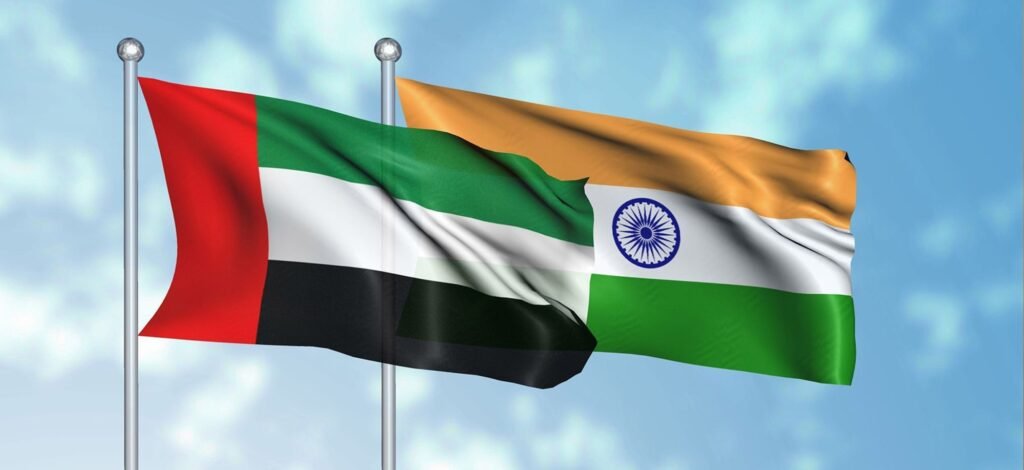
Dubai, United Arab Emirates – September 2025: The India-UAE Comprehensive Economic Partnership Agreement (CEPA), which came into force on May 1, 2022, has emerged as one of Asia’s most important trade corridors. By driving tariff cuts, easing the movement of people, and simplifying rules of origin, the pact is transforming the non-oil trade landscape between the two nations. With ambitious targets of achieving US$100 billion in non-oil trade by 2030, both countries are leveraging CEPA to deepen bilateral ties, expand logistics networks, and create new pathways for small and medium-sized enterprises, pharmaceuticals, and services.
Trade Diversification and Growth Since CEPA
The results of CEPA have been striking. India-UAE merchandise trade nearly doubled in three years, climbing from US$43.3 billion in FY 2020-21 to US$83.7 billion in FY 2023-24. Non-oil trade made up US$57.8 billion of this total. In the first half of 2025 alone, non-oil trade surged to nearly US$38 billion, representing a robust 34 percent year-on-year increase.
India’s export profile has also diversified beyond traditional gems, petroleum products, and food. Smartphones, engineering goods, and chemicals have gained significant traction. Engineering goods dominate exports at 26.67 percent, while electronics have become the fastest-growing category, expanding by 32.46 percent in FY 2024-25 to reach US$38.58 billion. Notably, smartphone exports to the UAE reached US$2.57 billion in FY 2023-24. Pharmaceuticals, textiles, and marine products have also benefited from simplified customs procedures and automatic registration, reinforcing India’s position as a reliable supplier to the UAE.
Although India continues to run an overall trade deficit with the UAE, the gap has narrowed significantly. Non-oil exports rose to US$27.4 billion in FY 2023-24, growing at an impressive 25.6 percent annual average since CEPA’s launch.
Tariff Elimination and Rules of Origin
At the heart of CEPA’s success lies its extensive tariff concessions. The UAE removed duties on 97 percent of tariff lines, covering 99 percent of India’s exports by value. Over 6,090 products (80.3 percent of tariff lines) became duty-free immediately, while others are scheduled for phased reductions over the next decade. India, in return, eliminated tariffs on 64.6 percent of products instantly, while committing to gradual reductions for nearly 20 percent of goods over five to ten years. Sensitive products such as dairy, cereals, fruits, and tea remain excluded to protect India’s domestic producers.
CEPA also enforces strict rules of origin to ensure benefits go to genuine producers. Agricultural exports must be wholly obtained, chemicals require at least 40 percent value addition, and steel is subject to the “melt and pour” clause. Direct exports alone qualify for preferential treatment, ruling out transshipped goods.
The system has become increasingly efficient with the Directorate General of Foreign Trade (DGFT) issuing more than 240,000 certificates of origin since 2022. These certificates have facilitated preferential exports worth US$19.87 billion, underscoring the pact’s role in trade facilitation.
Tackling Non-Tariff Barriers
While tariff reductions have boosted trade, CEPA also addresses non-tariff barriers. Although challenges remain in certain sectors—such as toys requiring GCC G-mark authorization and Indian textiles facing complex local content rules—progress has been made. The number of technical and sanitary notifications has declined, and customs procedures are becoming faster and more predictable. This shift is easing compliance burdens for exporters and improving the competitiveness of Indian goods in the UAE market.
Services and Investment Flows
Beyond goods, CEPA has opened new doors in services and investment. India has committed across 100 sub-sectors, while the UAE extended commitments across 111 sub-sectors, including critical areas like computer services, consultancy, R&D, healthcare operations, and air transport. The UAE has also committed to 100 percent foreign ownership in several industries, attracting Indian investors to set up operations in the Emirates.
For professionals, CEPA provides enhanced mobility: business visitors can stay up to 90 days, contractual service suppliers up to one year, and intra-corporate transferees up to three years. These provisions have already encouraged cross-border collaborations in technology, healthcare, and consulting.
UAE as a Re-Export and Transshipment Hub
The UAE’s strategic role as a re-export hub has grown under CEPA. The Jebel Ali Free Zone (Jafza) hosts more than 2,300 Indian companies employing about 15,000 people. In 2024, trade volumes between India and Jafza rose by 40 percent, while trade value increased by 17 percent. Jafza also welcomed 283 new Indian firms in 2024, a 15 percent year-on-year increase.
A key development is the Bharat Mart project, set to open in 2026 at Jafza. The initiative will provide 2.7 million square feet of retail, logistics, and warehousing space linked to Jebel Ali Port, Al Maktoum Airport, and Etihad Rail. With over 1,500 showrooms and incubation zones for women-led enterprises, Bharat Mart is expected to cement the UAE’s role as India’s primary export platform for the Middle East and Africa.
India, however, has clarified that it will not use the UAE as a transshipment base for goods destined for the US, citing tariff and compliance risks. Instead, re-exports from the UAE are being targeted toward Asia and Africa, aligning with broader regional trade integration.
Regulations and Compliance Requirements
For Indian exporters, compliance remains critical. Unlike the UAE, where certificates of origin are centralized under the Ministry of Economy, India requires interaction with multiple agencies, with 18 authorized bodies issuing certificates. Exporters must adhere to product-specific rules such as Change in Tariff Classification (CTC) or Qualifying Value Content (QVC) to prove substantial transformation.
The Tariff Rate Quota (TRQ) system also regulates preferential imports. Products like gold, plastic goods, and copper fall under TRQ mechanisms, ensuring that only a capped volume enjoys zero-duty access. For example, Low-density Polyethylene imports into India are capped at 50,000 MT annually at 0 percent tariff, with quantities above this level attracting a 7.5 percent duty.
The pharmaceutical sector has emerged as a standout beneficiary. Indian drug makers enjoy a 90-day automatic registration and market authorization in the UAE. Medicines approved by regulators such as the US FDA, UK MHRA, EU EMA, and Japan PMDA are exempt from additional testing, cutting costs and accelerating entry into the UAE market.
SME and MSME Support Systems
Recognizing the importance of smaller businesses, CEPA includes provisions to support SMEs and MSMEs. A Joint SME Committee fosters collaboration between Indian and Emirati firms, while Indian initiatives like the Market Access Initiative and International Cooperation Scheme provide funding support for participation in UAE trade fairs and exhibitions.
On the UAE side, the Abu Dhabi Chamber of Commerce reported a 10.3 percent year-on-year increase in certificates of origin issued to MSMEs between June 2024 and June 2025. Training programs, matchmaking platforms, and targeted support are helping small businesses integrate into cross-border supply chains, strengthening the bilateral trade ecosystem.
Long-Term Outlook
The India-UAE CEPA stands as a benchmark for modern trade agreements, balancing tariff relief, service liberalization, and SME promotion with robust compliance measures. With initiatives such as the India-Middle East Economic Corridor (IMEC) and the Bharat Mart project, both nations are positioning themselves for sustained growth.
Analysts predict that by 2030, India and the UAE will not only achieve their US$100 billion non-oil trade target but also establish themselves as leaders in sustainable trade, logistics innovation, and SME integration. For businesses across sectors—from smartphones and engineering goods to pharmaceuticals and textiles—the CEPA offers a powerful framework to expand into one of the world’s fastest-growing bilateral trade corridors.